Phrase (Basic ㊦ 274)
It won’t do if someone does not take some action or if someone or something is not in some state.
Equivalent: Have to; must; need
| (i) Vnegative | なければならない | |
| 話さなければならない | Someone has to talk | |
| 食べなければならない | Someone has to eat | |
| (ii) Adjective い stem | くなければならない | |
| 安くなければならない | Something has to be inexpensive | |
| (iii) {Adjective な stem/ Noun} | でなければならない | |
| 静かでなければならない | Something has to be quiet | |
| 先生でなければならない | Someone has to be a teacher |
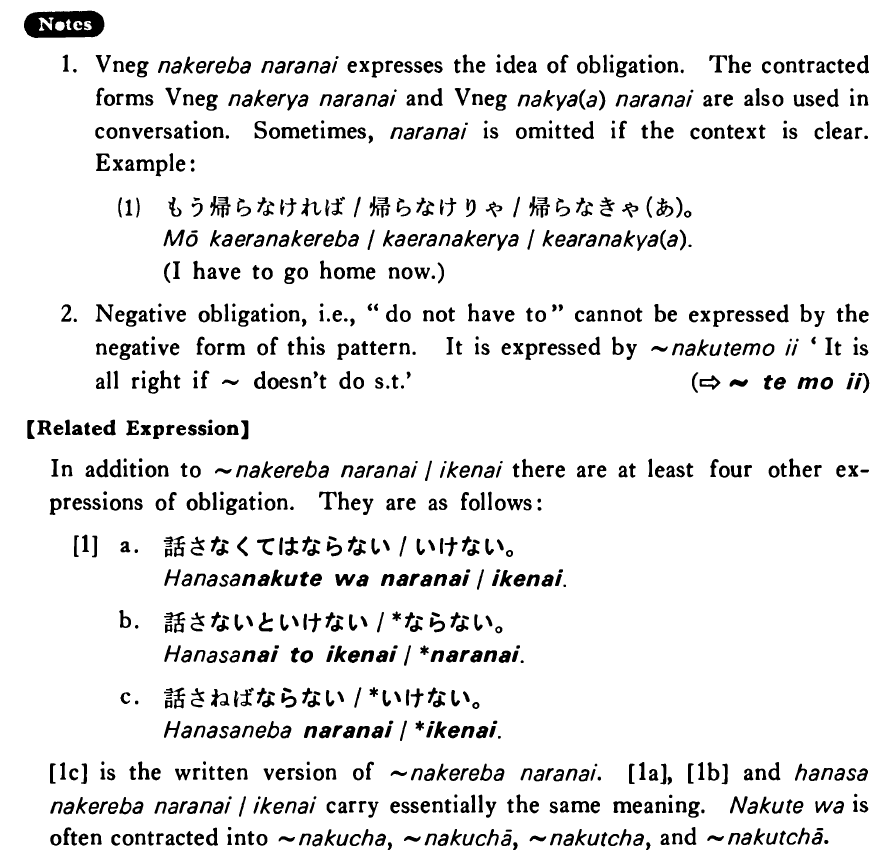
1. Verb negative なければならない expresses the idea of obligation. The contracted forms Verb negative なけりゃならない and Verb negative なきゃ(あ)ならない are also used in conversation. Sometimes, ならない is omitted if the context is clear. Example:
2. Negative obligation, i.e., "do not have to" cannot be expressed by the negative form of this pattern. It is expressed by なくてもいい 'It is all right if ~ doesn't do something.'
(⇨ てもいい)
【Related Expression】
In addition to なければならない/いけない there are at least four other expressions of obligation. They are as follows:
[1]
[1c] is the written version なければならない. [1a], [1b] and 話さなければならない/いけない carry essentially the same meaning. なくては is often contracted into なくちゃ, なくちゃあ, なくっちゃ, and なくっちゃあ.